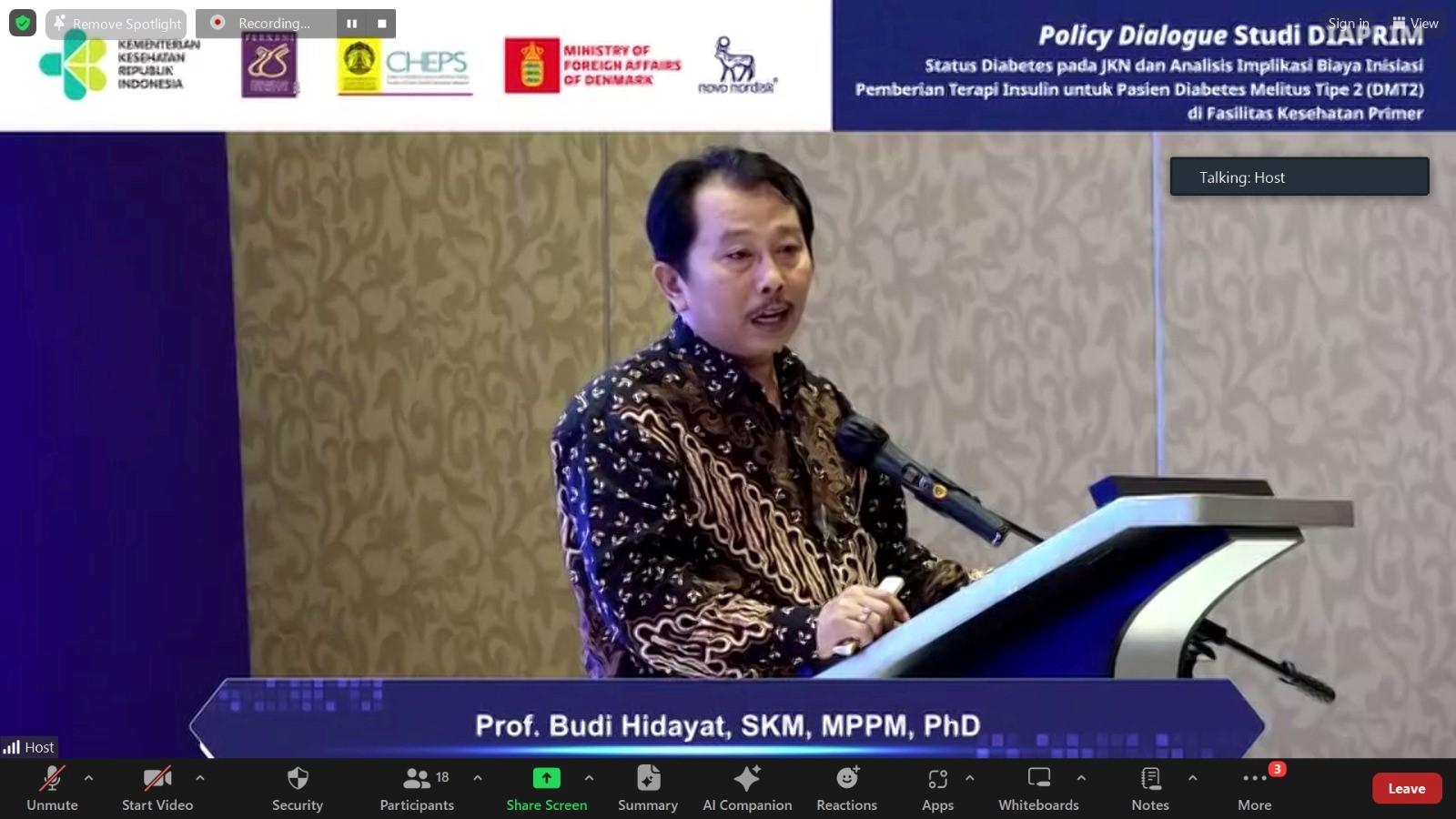
DIAPRIM Study - Policy Dialogue
On November 14, 2023, the Policy Dialogue event for the DIAPRIM Study was held to commemorate World Diabetes Day (WDD). This event aimed to address the issue of diabetes mellitus (DM), particularly insulin therapy in Indonesia. DM has become one of the global health emergencies with the fastest growth in the 21st century.
The discussion brought together various stakeholders from different backgrounds, including representatives from the Directorate of Pharmaceutical Management and Services of the Directorate of Public Health Governance of the Indonesian Ministry of Health, the Directorate of Primary Health Care Services of the Indonesian Ministry of Health, the Directorate of Prevention and Control of Non-Communicable Diseases of the Indonesian Ministry of Health, the Center for Health Financing and Decentralization Policy, the Directorate of Health Service Guarantee of BPJS Health, the Health Benefit Guarantee Policy Division of BPJS Health, non-governmental organizations, the Indonesian Society of Endocrinology (PERKENI), the Association of Indonesian Health Offices (ADINKES), the Indonesian Diabetes Association (PERSADIA), the Indonesian Association of Community Health Centers (APKESMI), the Association of Indonesian Clinics (ASKLIN), the Association of Public Health Pharmacy Seminars (HISFARKESMAS), CHEPS FKM UI, and the general public.
The main objective of this event was to discover new insights and formulate recommendations to support the management and treatment of diabetes patients in Indonesia. Especially regarding the results of the DIAPRIM study, which showed that the Net Benefit of shifting insulin to FKTP was around RP 21T - 22 T (14% savings from the current insulin delivery model at FKRTL) or an average of Rp 1.7 T per year. Shifting the Cost Proportion from FKRTL to FKTP can result in improvements in patient health outcomes and healthcare service system reform (health financing sub). The transition of insulin therapy initiation to FKTP not only impacts medical cost savings but also provides other benefits such as improving patient health outcomes and overall healthcare service system improvements. Recommendations from the DIAPRIM Study include Policy Innovation for Institutionalizing Disease Management Systems, insulin therapy initiation at FKTP as a concrete manifestation of primary healthcare transformation, and Remuneration Improvement at FKTP.
In the opening discussion, it was stated that there are approximately 2 million people with diabetes in Indonesia, but many of them are not aware of their health condition or have not been formally diagnosed. In fact, data shows that about 2/3 of people with DM remain undetected. In the context of efforts to prevent and manage diabetes, the Ministry of Health has taken concrete steps by transforming the Indonesian healthcare system. One of the main pillars of this transformation is screening for diseases, including DM, as part of the 9 priority referral diseases. Diabetes mellitus cannot be completely cured but can be prevented from causing serious complications. Therefore, strengthening promotive, preventive, early detection, and case management approaches is necessary to reduce the burden of diabetes in Indonesia. In a panel moderated by Prof Budi Hidayat, SKM, MPPM, PhD., the first panel discussed material related to the Readiness of Primary Health Facilities in initiating insulin therapy for type 2 diabetes mellitus (DMT2) patients, and the second panel presented material related to Regulatory Readiness in Initiating Insulin Therapy for Type 2 Diabetes Mellitus (DMT2) Patients.
This discussion served as an important opportunity for stakeholders to collectively develop more effective strategies in diabetes healthcare, especially insulin therapy at FKTPs in Indonesia. Through collaboration and synergy among various parties, it is hoped that significant positive changes will be achieved in the management of diabetes in FKTPs and public health as a whole.